Abstract: Official data released by the National Bureau of Statistics shows that the total floor area of newly started residential construction projects across China has maintained an overall upward trend in recent years, hitting 1.989 billion square meters in 2021. After a moderate drop in 2022 and 2023, the figure is expected to rebound to 2.315 billion square meters in the current year. As urbanization continues to advance, traditional construction practices have exposed obvious drawbacks including low operational efficiency, high energy consumption and severe pollution, which have made industrial transformation and upgrading an urgent necessity. Intelligent 3D printing construction, which features eco-friendly performance, high efficiency and innovative construction modes, has grown increasingly popular throughout China. Driven by ongoing technological progress, new-type building and green materials adapted to 3D concrete printing have garnered extensive attention from the entire construction industry.
1. Introduction
China is currently undergoing a new wave of technological revolution and industrial upgrading. The intelligent manufacturing approach, formed by the deep integration of information technology and advanced manufacturing technology, is bringing comprehensive and profound changes to the whole manufacturing sector. As a typical disruptive technology in modern manufacturing, 3D printing has gained rising recognition for its vital role in facilitating the intelligent transformation of the construction industry.
Over the past few years, Zhejiang Wengong Intelligent Technology Co., Ltd. has built long-term strategic cooperation with well-known universities including Shanghai Tongji University, Xi'an Jiaotong University and Harbin Institute of Technology, committed to promoting the practical application of 3D printing construction technology nationwide.
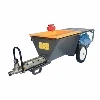
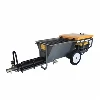
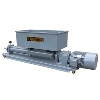
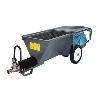
Many leading domestic intelligent technology enterprises, such as China Construction Technology Center, Yingchuang, China Construction Eighth Engineering Bureau, Aomeiri and Dajie, have adopted the WenGong 3D concrete printing pump in their projects. This industry practice fully proves that China's 3D building technology is in a state of rapid development and gradual maturity, making the research and application of 3D printed buildings extremely necessary.
2. Application Significance
2.1 The 3D concrete printing pump independently developed by WenGong integrates intelligent control modules, high-precision positioning functions and excellent material deposition performance. It provides solid technical support for the construction of 3D printed buildings and greatly boosts the developmental progress of domestic 3D building technology.
Adopting lithium batteries as the core power supply and equipped with low-voltage micro-electric power systems and dedicated charging piles, the WenGong JP10ZN 3D concrete printing pump can effectively optimize domestic construction methods and break the long-term reliance on conventional masonry construction techniques.
The JP10ZN equipment boasts mature and advanced technical configurations. It delivers fast response to operational commands, precise positioning without superposition offset, rapid molding efficiency and a wider range of mechanical movement.
2.2 3D printed building technology has become a major research hotspot in the construction industry in recent years. As a typical additive manufacturing method, 3D printing technology relies on computer program assistance. It creates complete three-dimensional solid building structures by continuously stacking and layering two-dimensional materials along the preset molding path. The technology stands out with multiple practical advantages, such as shorter construction cycles, higher working efficiency and lower overall project costs. At the same time, new green building materials compatible with 3D printing technology have also attracted wide industry attention.
3. Working Principle
3.1 Operators can generate complete three-dimensional digital models by importing traditional architectural and structural drawings into 3D printing equipment. The integration of intelligent technologies in equipment control and software programming effectively improves the overall efficiency and printing accuracy of 3D construction processes. Supported by automated operation programs, the matching computer vision recognition system and multi-functional sensors further enhance the intelligence level of the whole printing process. Optimized visual recognition technology ensures that 3D printed buildings achieve efficient construction, consistent surface appearance and accurate dimensional standards.
3.2 The built-in automatic positioning system enables accurate layout of steel mesh and various decorative components, effectively reducing manual operation steps and human-induced errors. In addition, VR virtual reality technology enables clients to experience customized personalized building solutions, which further reforms the traditional production-to-sales operation mode of the real estate industry.
4. Effects
The automated and intelligent attributes of 3D printing technology are subverting traditional construction modes and triggering a comprehensive innovation in the architectural construction field:
4.1 Effective reduction of material and labor costs: Mechanized and intelligent operations replace repetitive and tedious manual work in conventional construction. 3D printing construction produces almost no construction waste, cutting building material consumption by 30%-60% and manual labor input by 50%-80% compared with traditional construction methods. While retaining the original steel beam and column load-bearing structure, the technology supports pre-embedding of pipelines, doors and windows, and realizes integrated printing of internal and external wall decorations. This can shorten construction cycles by 50%-70% and greatly lower the overall investment of construction projects.
4.2 Stable guarantee of high-quality construction results: Fully automated production processes eliminate traditional manual wet construction work. It avoids various quality defects caused by manual operation errors, ensuring high construction quality and efficient project delivery.
4.3 Support for special-shaped building construction: Traditional bricklaying construction methods greatly limit the morphological design of buildings. In contrast, 3D printing technology supports free and flexible customization of building shapes. After completing the pre-design of building outlines and surface patterns, the prefabricated printed wall components can be directly assembled on the construction site.
5. Conclusion
From a technical perspective, 3D printed building technology realizes intelligent, cost-effective, eco-friendly and low-labor-intensity construction production. It also maximizes the recycling and utilization of waste building resources and achieves the cyclic reuse of building materials. The technology plays a vital guiding role in promoting the industrialization and intelligent upgrading of modern new-type construction, and supports the stable and sustainable development of the entire construction industry.
At present, Wengong keeps pace with industrial development trends, actively seizes the development opportunities brought by the booming intelligent industry. Focusing on technological innovation as the core development concept, the company devotes itself to technical research and breakthroughs in the field of 3D printed buildings, striving to create new developmental achievements in the industry.