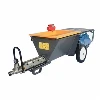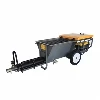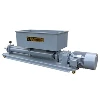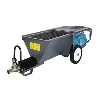
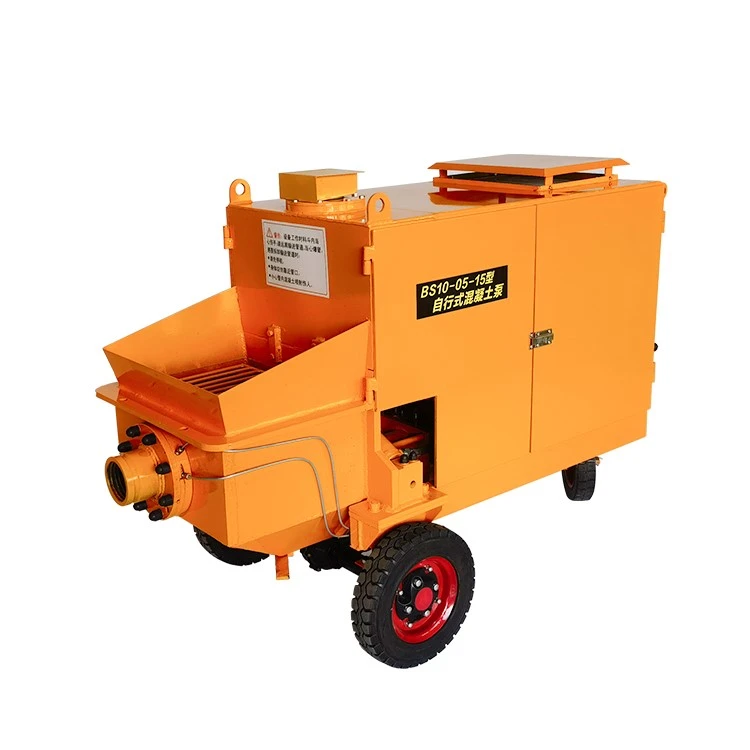
Piston-type concrete pumps are available in hydraulic and mechanical drive versions. A hydraulically driven concrete pump consists of a hopper, hydraulic cylinder and piston, concrete cylinder, distribution valve, Y-tube, flushing equipment, hydraulic system, and power system. The hydraulic system uses pressure to drive the piston in reciprocating motion. When the piston moves backward, it draws in material; when it moves forward, it forces the concrete from the concrete cylinder into the delivery pipe through the Y-tube. After pumping concrete, the pump body and delivery pipe are cleaned with high-pressure water or compressed air. The displacement of a piston-type concrete pump depends on the number and diameter of the concrete cylinders, the piston's reciprocating speed, and the volumetric efficiency of the concrete cylinder's suction capacity.
Extrusion-type concrete pumps come in three types: rotor-type (double roller), straight-pipe type (three roller), and belt-type (double-groove). The rotor-type double-roller concrete pump consists of a hopper, pump body, extrusion hose, vacuum system, and power system. The pump body is sealed; two planetary rollers are mounted on the rotor frame inside the pump body, and the inner wall of the pump body is lined with rubber pads, with extrusion hoses installed inside the pads. The power unit drives planetary rollers to rotate, crushing the extrusion hose and forcing the concrete inside into the delivery pipe for discharge. A vacuum system maintains a certain vacuum within the pump body, causing the extrusion hose to immediately return to its original shape after crushing and accelerating the intake of concrete from the hopper into the extrusion hose. The displacement of the extrusion concrete pump depends on the rotor's radius of rotation and rotational speed, the diameter of the extrusion hose, and the volumetric efficiency of the concrete intake.
The hydraulic diaphragm concrete pump consists of a hopper, pump body, diaphragm, control valve, pump, and water tank. The diaphragm is located within the pump body. When the pump draws water from below the diaphragm back to the water tank via the control valve, the diaphragm sinks, and concrete in the hopper forces open the check valve and enters the pump body. When the pump draws water from the water tank back to the pump body via the control valve, the pressurized water raises the diaphragm, closing the check valve and forcing the concrete into the delivery pipe for discharge. Concrete pumps have high productivity, capable of transporting concrete horizontally and vertically in a single operation. However, they require specific specifications regarding concrete mix proportions, aggregate size and gradation, cement dosage, and concrete slump to ensure optimal pumping efficiency.
Concrete Pump Power Systems:
Electric Motor-Powered Concrete Pumps: Diesel engine-powered concrete pumps can meet the needs of field construction sites and other operating environments without power. During pumping, the diesel engine's speed is detected by a speed sensor and transmitted to the control computer. Changes in pumping pressure cause corresponding changes in the diesel engine's speed. The control computer adjusts the throttle motor based on the detected speed changes, automatically regulating the diesel engine to operate at its optimal speed.
Plunger-Type Mortar Pumps: These pumps utilize the reciprocating motion of a plunger within a sealed cylinder to pressurize and deliver mortar. They consist of a plunger, cylinder, valves, power unit, pressure stabilizing device, and safety devices. The plunger is driven by a crank-connecting rod mechanism. When the plunger retracts, mortar enters the cylinder through the suction valve; when the plunger extends, the mortar is expelled through the discharge valve. There are two types of mortar pumps: single-plunger and double-plunger. To maintain a stable mortar flow, single-plunger mortar pumps are equipped with an air pressure stabilizing chamber. Double-plunger mortar pumps rely on the alternating motion of the working plunger and the compensating plunger to maintain a stable mortar flow. Single-plunger mortar pumps are suitable for mortar delivery and spraying plastering in buildings up to 10 stories, requiring sand to meet gradation requirements and not using only crushed sand. Double-plunger mortar pumps have higher pressure and are suitable for mortar delivery and spraying plastering in buildings up to 30 stories. They are more adaptable than single-plunger pumps, requiring only sand gradation and particle size, not specific geometry, and can use only crushed sand.
Diaphragm mortar pumps have the same working principle and application range as single-plunger mortar pumps. They utilize a reciprocating plunger to deform a rubber diaphragm through an intermediate liquid (usually water). When the diaphragm expands towards the pump cylinder, it forces mortar into the delivery pipe; when the diaphragm contracts, it draws new mortar from the container. Its characteristic is that the plunger does not directly contact the mortar, thus extending the plunger's service life. However, its structure is relatively complex, and the rubber diaphragm is prone to wear.
Pneumatic Mortar Pump: Utilizes compressed air to pressurize and deliver mortar. The main body is a horizontal pressure cylinder with a pressure cap on top. Inside the cylinder is a horizontal stirring shaft with stirring blades, driven by an electric motor or diesel engine through a gearbox. This type of pump is usually equipped with an air compressor, hydraulic hopper, dragline, and traveling device. The mortar can be prepared by its own stirring device, or prepared mortar can be directly loaded into the cylinder, the cap tightened, and compressed air connected to send it into the sealed pressure cylinder. During use, the discharge port is opened to press out the mortar. This machine has a wide range of applications; besides being used as a mortar conveying pump and mortar mixer, it can also be used to mix and transport fine aggregate concrete or dry materials.
Screw Mortar Pump: Utilizes a screw rotor rotating within an elastic stator to continuously transport mortar along the helical motion direction. It is available in dry and wet types. Dry screw pumps are suitable for applications involving pre-mixed dry materials. The pump's inlet is equipped with a mixer and a water inlet, which mixes the dry materials into a slurry before feeding it into the pump body. Wet screw pumps, like other types of slurry pumps, can only deliver pre-mixed slurry. Screw pumps are compact, lightweight, and provide stable material flow. However, the stator is prone to wear, requiring the use of oval-shaped sand. Their pressure is relatively low, making them suitable for applications with low conveying heights. They can also be placed on intermediate floors as relay pumps to increase the conveying height.