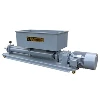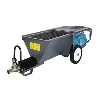
Slurry pumps are specialized equipment used in industrial fields to transport media containing solid particles, corrosive media, or acidic and alkaline media. They are commonly found in chemical, metallurgical, and environmental protection industries. Their core function is to achieve efficient media transport through mechanical energy conversion, making them particularly suitable for complex working conditions that traditional pumps struggle with. This article takes a single-stage horizontal slurry pump as an example to analyze its technical principles and key selection points.
Structural Design and Working Principle This type of pump is driven by an electric motor, with a horizontally arranged pump shaft (horizontal structure). Centrifugal force is generated through impeller rotation. Its impeller is a semi-open single-suction design, requiring only one impeller to complete media transport. Suction is done from one side. The pump body is made of engineering plastics, possessing acid and alkali resistance and wear resistance, allowing for long-term transport of corrosive liquids or media containing microparticles. Key parameters include: flow rate 20 m³/h (hourly transport capacity), head 30 m (lifting height), power 4 kW (energy consumption index), suction inlet diameter 50 mm, discharge outlet diameter 40 mm, and compatibility with 380V/220V voltage.
Technical Highlights and Applicable Scenarios
Compared to traditional centrifugal pumps, slurry pumps offer significantly improved media adaptability. The semi-open impeller structure reduces the risk of clogging, the single-stage design simplifies maintenance, and the engineering plastic material minimizes the impact of chemical corrosion. Typical applications include: acid and alkali solution transportation in the chemical industry, slurry treatment in the metallurgical field, and wastewater discharge in environmental engineering projects. Note that this equipment is not suitable for conveying high-viscosity media or media containing large solid particles; selection should be based on the media's particle size, concentration, and corrosiveness.
Operating Procedures and Safety Precautions
Before use, check that the motor rotation direction matches the pump body markings to avoid dry running or reverse rotation causing damage. When starting, close the outlet valve first, and gradually open it after normal operation. During operation, monitor current, vibration, and temperature parameters; immediately stop the machine and investigate if abnormalities are detected. For long-term shutdown, drain the pump to prevent sediment buildup and clogging. It is recommended to check seal wear every 3 months and change the lubricating oil annually to ensure equipment stability.
Key Parameter Analysis for Pump Selection
Flow rate, head, and power are the core indicators: flow rate determines conveying efficiency, head affects vertical lifting capacity, and power relates to energy consumption costs. Material selection must match the characteristics of the medium; for example, strong acid environments require polypropylene (PP) or polyvinylidene fluoride (PVDF). Regarding structural parameters, the suction inlet diameter must be greater than 1.5 times the diameter of the largest particle in the medium, and the discharge outlet diameter should be matched according to the pipeline system. Single-stage designs are suitable for short-distance conveying; long-distance conveying requires consideration of multi-stage pump solutions.